
First hour on site: $80–$180
Covers getting a licensed plumber to you and starting the work. Ask before booking, not after the invoice arrives.
Hot water that has given up, a mixer that drips, a toilet that runs, a leak showing on a wall, a gas appliance that needs connecting properly. All of it is licensed work, all of it is what we do, and you get the number before anyone picks up a tool.
Licensed plumbing covers far more than most people picture. Water supply and drainage inside the property, hot water units and their valves, tapware and toilets, gas appliance connections, stormwater pits and downpipes, and every fixture position behind a renovation are all inside it, and all of it carries a licence requirement in NSW.
Knowing that is genuinely useful when you are choosing who to call. A handyman may not legally touch gas, and stormwater is plumbing rather than landscaping. Asking for a licence number before anyone starts takes thirty seconds and rules out the jobs that have to be done twice.


A tank or heat pump mounted on an exposed elevation near the water works harder for its life than the same unit two streets inland. Casings corrode, anodes go faster, and the sacrificial parts that protect a tank need checking sooner than the manual suggests.
The cheap intervention is the anode. Checked at the right interval it can add years to a tank; ignored, it is the reason a unit that should have lasted a decade needs replacing at seven.
Streets falling toward the coast can send heavy rain rushing into pits and lines, when these are blocked, water backs up. We keep them flowing.
Slope changes the job before anyone picks up a tool. Access is the first question: whether there is somewhere to park within hose reach, whether the only way in is a set of stairs, whether a machine can get to the back at all or everything is carried.
Tell us on the phone rather than at the gate. It decides what comes off the van and, on a bad access job, whether one plumber or two is honest.
The moment worth planning for is a renovation. New fixtures, a second bathroom or a kitchen moved to the other side of the house all put more through a line that was sized and laid for a smaller household.
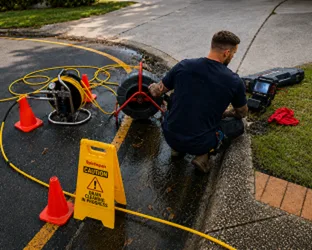
Much of Waverley’s older housing still runs on original clay and earthenware pipes prone to cracks, sags and root intrusion. CCTV shows us exactly what’s going on.
A camera run before the tiler starts costs a fraction of what it costs afterwards, and it is the difference between finding a sagging section while the slab is open and finding it through a finished floor. If you are getting quotes for a bathroom, get this done in the same fortnight.
Most homes around Waverley have a low grate outside, usually near a back step or beside the laundry wall, that nobody thinks about until the day it runs. It is set deliberately below the lowest fixture inside so that when something downstream stops taking water, it spills into the garden rather than through your floor.
If yours is buried under mulch, pavers or a new deck, that protection is gone and nobody will notice until the overflow finds the hallway instead. Finding it and keeping it clear is a five minute job that has saved a lot of carpet.
A downpour is a free diagnostic if you watch during it. Where water pools, which downpipe backs up at the head, whether the gully runs, whether anything smells afterwards: those four observations narrow a stormwater fault down more than an hour of guessing on a dry day.
Write down what you saw and when. A plumber arriving to a dry, tidy yard is working blind otherwise, and the difference between a clean-out and a repair is usually decided by whether it happens every time or happened once.
Water moving downhill fast is not automatically good. On a steep run the liquid can outrun what it is carrying, and the solids settle at the first flat section rather than continuing. That is why a fault on a sloping block often recurs at the same point regardless of how careful the household is.
It is a gradient problem, not a usage problem, and no amount of careful flushing fixes it. Seeing the profile of the line is what turns it into a defined repair instead of an annual visit.
An unexplained jump in a water bill is one of the most solvable problems there is, and one of the most commonly ignored until it has run for a year. The test is simple: turn every tap and appliance off, then watch the meter. If the dial is still moving, water is going somewhere.
From there it is a matter of narrowing it down, and most concealed leaks are found without opening anything. Doing it early is the difference between a fitting and a damaged wall.
Covers getting a licensed plumber to you and starting the work. Ask before booking, not after the invoice arrives.
Business hours across Sydney in 2026. Out-of-hours work costs more for the obvious reason and should be disclosed up front.
One fixture, one visit, minor parts included. Taps, toilets, valves and the flexible hoses that quietly fail.
Elements, thermostats, tempering valves and anodes. Worth doing on a tank with years left, not worth doing on one that is corroded through.
Renovation rough-in, gas work and excavation get a written number before a tool comes out, not an estimate that drifts.
Indicative Sydney ranges for 2026. Your job gets a fixed price before work starts. Figures here are indicative of the 2026 Sydney market rather than a quote from us, you get your own number as a fixed price before any work starts.
You get a tradesperson on the phone rather than a booking agent reading a script. Most faults can be narrowed down from the description alone, including the ones that do not need a visit.
Whoever is working closest to Waverley takes it, which is why same-day is usually possible and why the van already carries what the job is likely to need.
We find the actual cause rather than the visible symptom, show you, and give you a fixed figure. You decide with the number in front of you.

The repair is finished and proven on the spot, the site is left tidy, and any certificate the work requires comes with it.
Leave your details and a licensed plumber will call back, tell you what it is likely to be, and book it only if it actually needs booking.
Licensing, pricing, timing and the things worth asking before anyone starts.

Ring us and a tradesperson picks up. Or leave your details and we will call back with a window we can actually meet.

Leave your details and our local Waverley team will call you back fast.